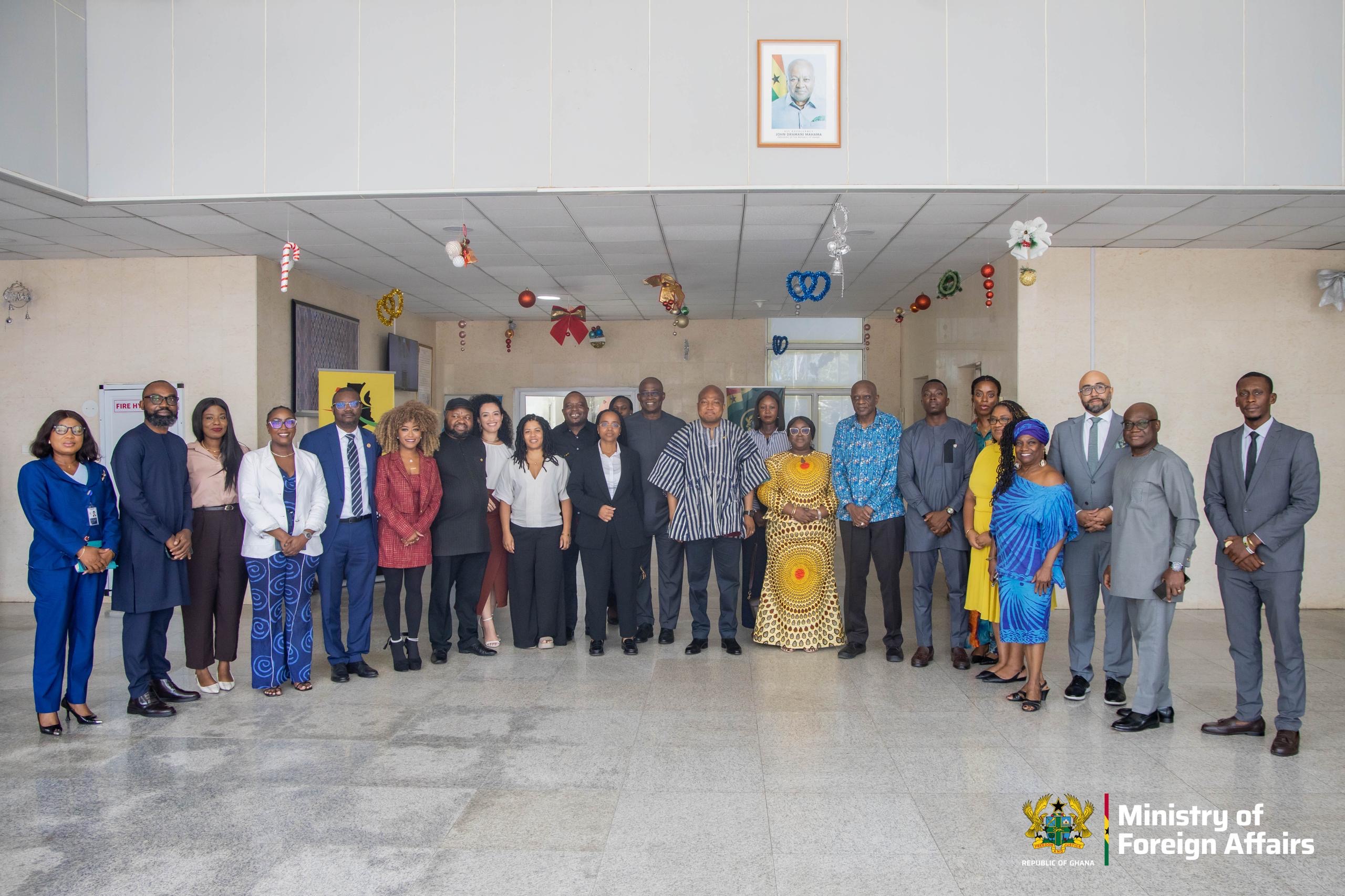
As part of Ghana’s continuing efforts to advance the reparative justice agenda, the Minister for Foreign Affairs, Honourable Samuel Okudzeto Ablakwa (MP) held a meeting with a Group of Experts and Advocates for reparations on Wednesday, 17th December, 2025. They included Experts from the African Union Economic, Social and Cultural Council (ECOSOCC), Trust Africa and Reform Initiative who are based in Africa, the Caribbean, Latin America, Europe, and the United States.
Welcoming the delegation, Honourable Samuel Okudzeto Ablakwa (MP) underlined Ghana’s firm commitment to the reparative justice agenda and mentioned that Ghana had been consistent in championing the interests of Africans and people of African descent and would continue to do so.
The Honourable Minister further noted that the time had come for responsibility to be taken for the historical atrocities committed through slavery and colonialism and added that the call for reparations is about justice and dignity. He stressed that the President of the Republic of Ghana and African Union Champion for Reparations, His Excellency John Dramani Mahama remains committed to mobilising support to advance the agenda.
The Special Envoy for Reparations, Dr. Ekwow Spio-Garbrah lauded the Experts for the vast work done in the field of reparations and committed to working together to advance the cause to achieve the set objectives.
The Chief Director, Ambassador Khadija Iddrisu emphasised the need for a roadmap and a unified voice to strengthen the global reparations movement to ensure its success. She stressed the importance of using shared knowledge, strong partnerships, and practical strategies to strengthen Africa’s case for reparations and translate advocacy into action.
On their part, the Experts assured of their solidarity and commended Ghana for its role in the pursuit of reparative justice and putting in place a structure through which efforts could be coordinated by appointing a Special Envoy. They proffered some recommendations which could further strengthen the drive including sustained education to give clarity and direction to the intended audience, regular and structured dialogue on reparations at national, continental, and global levels, building of registers, among others.