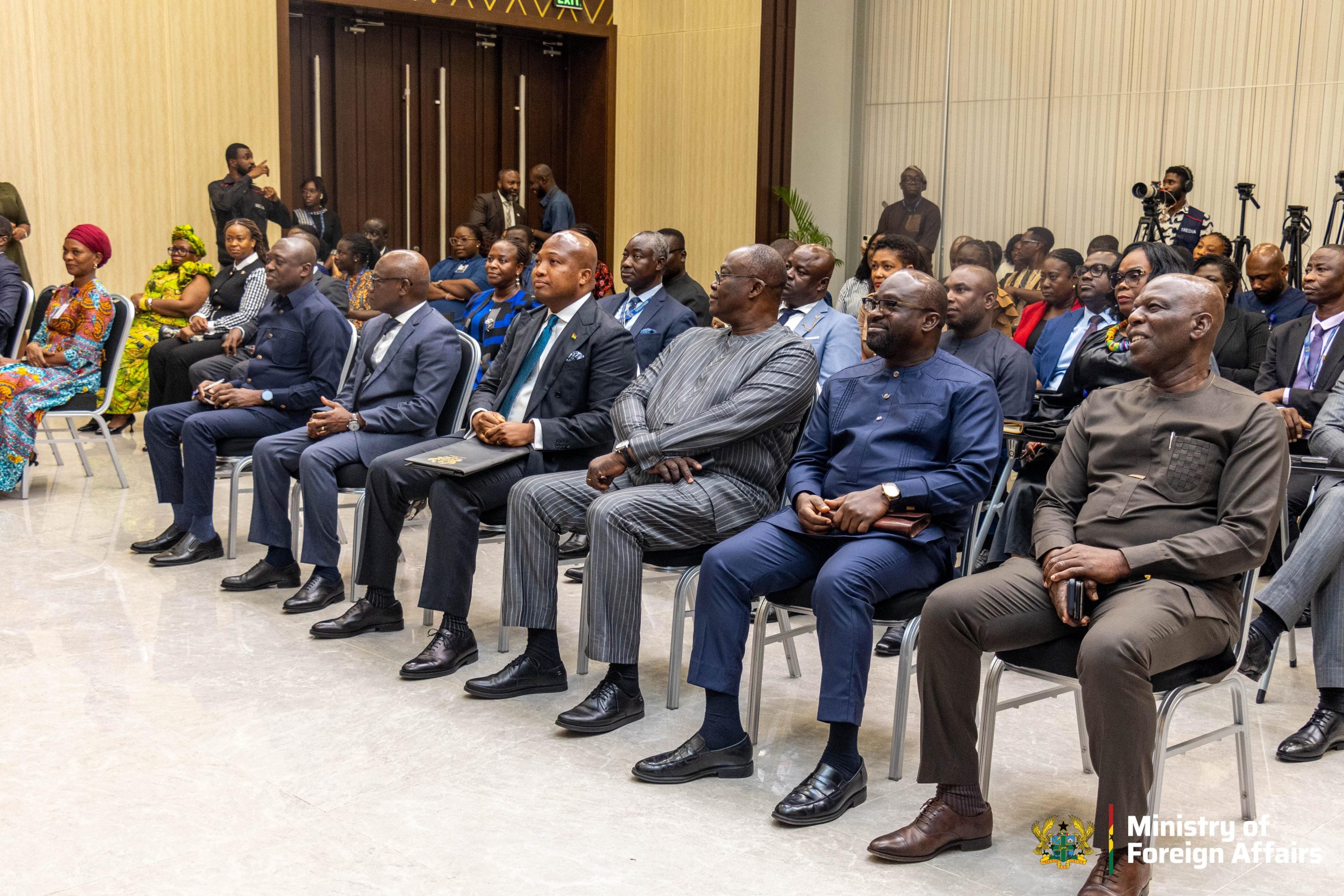
The Minister for Foreign Affairs, Honourable Samuel Okudzeto Ablakwa (MP) on Tuesday, 31st March, 2026 briefed the Press on the adoption of a historic United Nations General Assembly resolution declaring the trafficking of enslaved Africans and Racialised Chattel Enslavement of Africans as the Gravest Crime against Humanity. The objective of the Press Conference was to present the facts about the resolution.
Addressing the Press, the Honourable Minister stated that resolution A/RES/80/250 championed by His Excellency John Dramani Mahama, President of the Republic of Ghana in his capacity as the African Union Champion on Reparations was adopted on 25th March 2026 which was also the International Day of Remembrance of the Victims of Slavery and Transatlantic Slave Trade. 123 Member States of the United Nations voted in favour of the resolution, 3 against and 52 abstentions, marking a significant milestone in global efforts to address the enduring legacy of the transatlantic slave trade.
He noted that the adoption of the resolution signals a shift in the international community’s approach from commemoration to acknowledgment of the structural consequences of the transatlantic slave trade and the need to advance dialogue on reparatory justice. He stated that the narrative that the transatlantic slavery was a trading system with the involvement of Africa is a strategy to divide the front of Africans and People of African Descent. He explained that transpired was not trade in its true sense of the word. Trade requires consent, exchange and agency. However, what happened was the exact opposite as Africans were captured through raids and coercion, transported in chains, confined in inhumane conditions and subjected to violence at every stage from inland capture to coastal detention to the Middle Passage across the Atlantic. This was a system of organised human trafficking and exploitation driven by external demand, financed through transcontinental networks and codified through legal regimes developed outside the African continent. He opined that although instances of local intermediaries existed, this did not amount to control or ownership of the system and therefore, cannot be interpreted as equal participation.
The Minister further stated that the call for reparatory justice is not a demand for direct payment to leaders but the need to address the enduring consequences of historical injustices and to support programmes and initiatives in areas including education, infrastructure development for affected communities. He stated emphatically that no amount of compensation can fully account for the scale of the atrocities and their lasting impact.
He added that the resolution provides a framework for engagement on reparatory justice, including dialogue on compensation and institutional reforms, as well as enhanced cooperation in education, research, and cultural restitution.
Honourable Ablakwa expressed profound gratitude to the African Union, CARICOM and
the Community of Latin American and Caribbean States (CELAC) and all the 123 Member States who voted in favour of the resolution and all our international partners including the Congressional Black Caucus, Reform Initiatives, Pan-African Lawyers Union (PALU), National Association for the Advancement of Colored People (NAACP), National Action Network (NAN), African Union Committee of Experts on Reparations (AUCER), African Union Legal Experts on Reparations (AULER), Rev. Al Sharpton, Ben Crump, Bell Ribeiro-Addy (MP) of the House of Commons of United Kingdom, Zohran Kwame Mamdani, Mayor of New York City, Prof. Sir Hilary McDonald Beckles and Prof. Verene Albertha Shepherd as well as other regional and international experts, historians, academics, researchers, jurists, and activists whose collaboration and support were instrumental in building the broad global coalition that resulted in the adoption of the resolution.
