The High-Level Consultative Conference on the Next Steps to the Landmark United Nations Resolution on the Trafficking of Enslaved Africans was held in Accra, Ghana from 17th to 19th June, 2026 under the auspices of the President of the Republic of Ghana and African Union Champion on Advancing the Cause of Justice and the Payment of Reparations, His Excellency John Dramani Mahama with the view to charting a practical roadmap for advancing the reparatory justice agenda. It is recalled that on 25th March, 2026 President Mahama tabled a resolution at the United Nations General Assembly to declare the trafficking of enslaved Africans and racialised chattel enslavement of Africans as the gravest crime against humanity. At the end of the proceedings of the Assembly, 123 Member States voted in favour, with 56 abstentions and 3 votes against the resolution.
Cognisant that others have different political and legal perspectives regarding the reparatory justice agenda even after the adoption of Resolution A/RES/80/250, President Mahama hold the view that it is imperative to expand the circle to encourage dialogue over silence and engagement over distance. Based on this inclusive approach in pursuing reparatory justice, some institutions and countries have openly acknowledged their role in perpetuating such injustice against humanity and subsequently apologised.
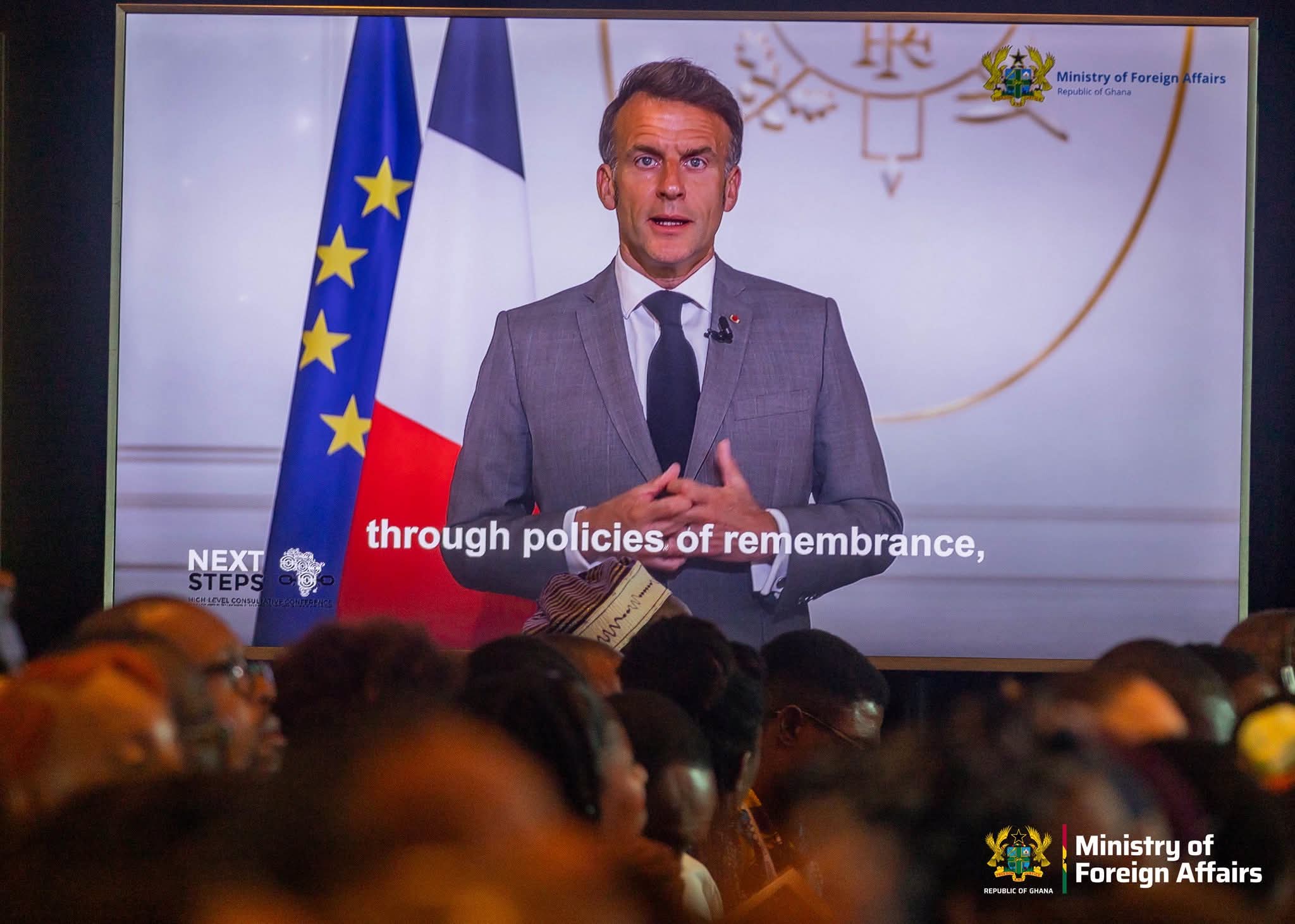
The President of the Republic of France, His Excellency Emmanuel Macron addressed the Consultative Conference via video and reaffirmed France’s commitment to advancing dialogue on the legacy of slavery and the transatlantic slave trade. He highlighted France’s ongoing efforts to confront historical injustices through historical research, initiatives aimed at preserving the collective memory of slavery, among others. He also underscored France’s commitment to supporting academic research on colonial history, slavery and the slave trade.
Commending Ghana for its leadership in advancing the landmark United Nations Resolution, President Macron expressed France’s readiness to work closely with Ghana, international organisations and other partners to advance scientific research, promote historical truth, foster constructive dialogue and support efforts towards reparatory justice. He reaffirmed France’s determination to contribute to collective efforts aimed at recognition, reconciliation and building a shared future. He stated that France has taken steps to confront the legacy of slavery and colonialism, including the repeal and repudiation of the Code Noir, the 1685 royal decree that regulated and institutionalised slavery in French colonies. He noted that such efforts formed part of France’s broader commitment to acknowledging historical injustices, promoting historical truth and advancing dialogue on reconciliation and justice.
In a goodwill message delivered via video, the Minister of Foreign Affairs of the Kingdom of Denmark, His Excellency Lars Løkke Rasmussen described the transatlantic slave trade as one of the darkest chapters in world history and acknowledged Denmark’s role in the injustice perpetuated against humanity. He admitted the importance of confronting the past, preserving its memory and drawing lessons for future generations and assured of Denmark’s commitment to combating slavery and human trafficking in all its forms. He further expressed Denmark’s readiness to continue constructive dialogue on addressing the legacy of slavery. He then commended Ghana for its leadership role in the reparatory justice agenda and pledged Denmark’s support for the initiative to establish a museum and memorial to preserve the history of the transatlantic enslavement to promote education and remembrance for future generations.
In a symbolic presentation, the Ambassadors of the Kingdom of the Netherlands and Federal Republic of Germany to Ghana, His Excellency Jeroen Verheul and His Excellency Frederik Landshöft respectively presented catalogues of cultural items believed to have been taken unlawfully during the dark era and indicated their countries readiness to return them.
His Excellency Jeroen Verheul in his remarks recalled the formal apologies offered by former Dutch Prime Minister His Excellency Mark Rutte in 2022 and by King Willem-Alexander in 2023 for the Netherlands’ involvement in slavery and the slave trade.
On his part, His Excellency Frederik Landshöft noted that Germany views the restitution of cultural heritage as an important step towards acknowledging historical injustices and fostering reconciliation.
Engaging all is important in determining how humanity responds to the need to address the enduring legacy of the gravest crime against humanity.